
ASAPTickets Redesign
B2C, Travel Agency (TA) Product with travel agent interaction for airline ticket bookings, supporting all specter of user’s needs.
Goals & Outcomes
The goal was to modernize the ASAPTickets travel booking experiencewhile preserving the company’s Call to Book business model.
The project focused on improving usability, trust, and conversion across two major product areas: the public facing LeadGen domain and the Payment domain.
The work resulted in a refreshed product experience, redesigned conversion focused pages, a restructured payment journey, and a more scalable visual foundation shared with other Trevolution products.
- Refreshed the ASAPTickets visual language and core product experience
- Redesigned the LeadGen journey around clearer conversion paths
- Rebuilt the Payment experience into a structured multi step checkout
- Introduced clearer trust elements and better information hierarchy
- Added new cross sell opportunities without overloading the booking flow
- New landing pages outperformed the previous versions
- Product changes contributed to stabilizing conversion and engagement trends during 2023 and 2024
Overview
ASAPTickets is a travel agency built around a Call to Book model.
Users can search for flights online, review available fares, and then connect with a travel agent to receive assistance and complete the booking. The product combines digital discovery with human supported sales and service.
The redesign covered two connected domains. The LeadGen domain introduces the service, helps users search for flights, and encourages them to call or submit a quote request. The Payment domain supports the later stages of the journey, where users review flight details, add services and products, and complete the purchase with or without agent assistance.
Challenge
The product had accumulated years of legacy design decisions, technical limitations, and inconsistent interface patterns.
Users faced cluttered pages, weak hierarchy, outdated visuals, confusing layouts, unclear pricing communication, and several moments where the interface did not match their expectations of a trustworthy travel service.
The challenge was to improve usability and credibility without breaking the existing business model or removing the assisted booking experience that remained commercially important.
UX Analysis & User Persona
The redesign started with a combination of quantitative and qualitative research.
I analyzed product behavior through Google Analytics, Looker, Hotjar session recordings and heatmaps, while surveys and interviews with returning users helped explain the patterns behind the numbers.
The core audience consisted largely of senior expats living in the United States, including users from Asian communities who frequently travelled internationally with family and also booked domestic trips.
The research revealed several recurring problems:
- Banner blindness
- Confusing layouts
- Weak or unclear calls to action
- Pricing transparency concerns
- Gaps between user expectations and the service experience
- Outdated visual patterns that reduced trust
- Similarity to competitors associated with negative travel experiences
These findings shaped both the UX priorities and the visual direction of the redesign.
Brand Refreshment
The product needed a fresher identity, but the goal was not to replace the existing brand completely.
I worked with Graphic and Brand Designers to evolve the visual language into something brighter, more modern, and more trustworthy while preserving the recognizable character of ASAPTickets.
My role was to connect the brand work with the product experience, making sure that visual changes supported usability, trust, conversion, and the core value proposition rather than existing only as decoration.
LeadGen Domain Refreshment
The original LeadGen experience contained too many competing elements, visual distractions, and unnecessary steps. This made the journey harder to understand for both senior users and younger visitors who expected a more direct digital booking experience.
The redesign simplified the page structure, reduced clutter, improved visual hierarchy, and created clearer paths toward the main conversion actions.
The updated pages also aligned the public facing experience with the refreshed ASAPTickets identity.
Payment Domain Refreshment
The Payment domain had some of the most significant usability and technical problems.
The legacy experience included outdated UI, unexpected technical errors, poorly sized interface elements, excessive visual clutter, and too many tasks placed on a single page. There was no clear multi step checkout, which made the purchase flow feel overwhelming and difficult to scan.
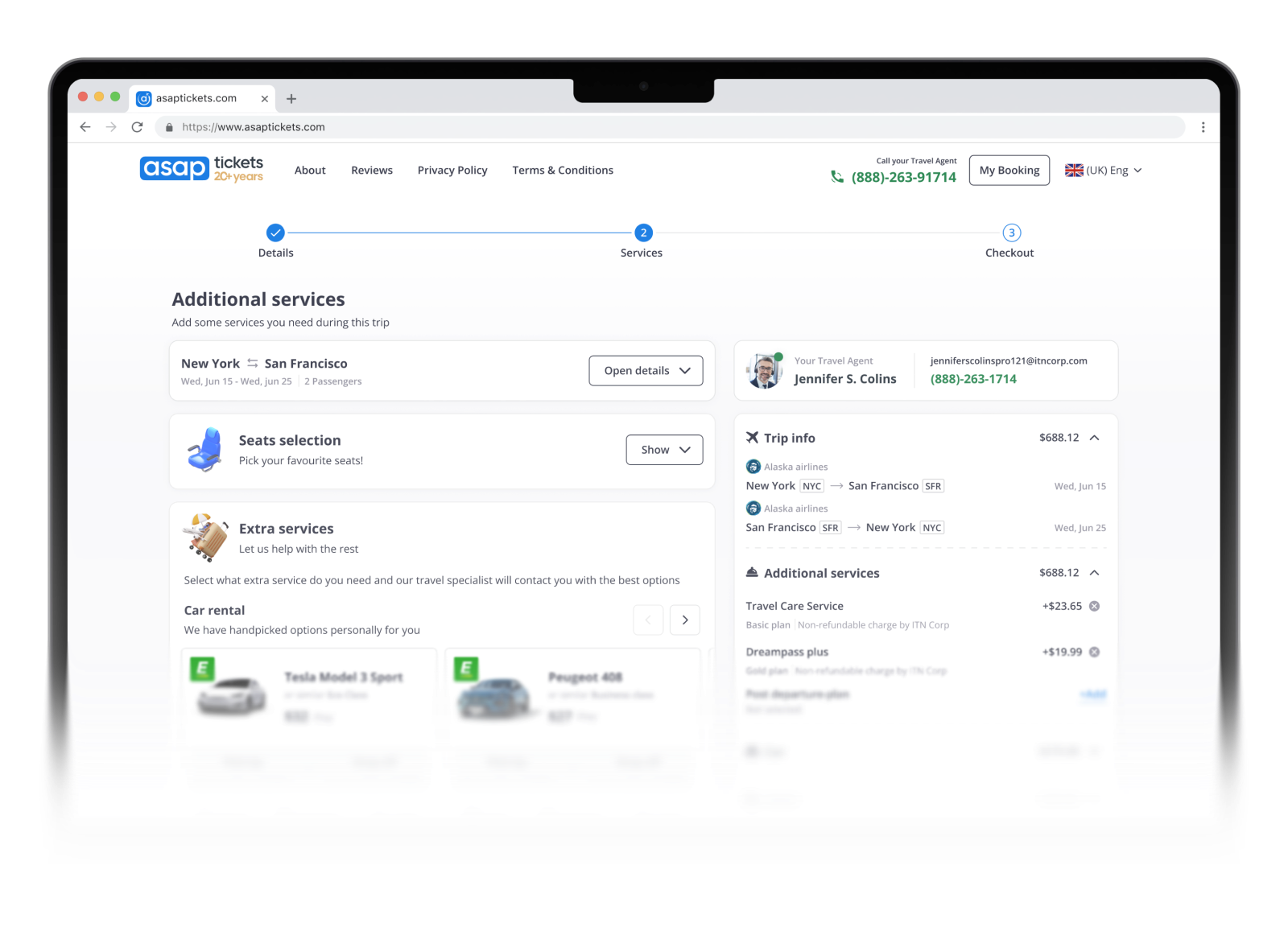
The redesign introduced a structured multi step payment experience with clearer hierarchy, more predictable interaction patterns, improved trust elements, and better separation between booking tasks.
Cross Sell Structure
The redesigned Payment flow also needed to support several new products and services without making the experience feel overloaded, so I organized the cross sells around the user’s booking context and the stage of the journey.
Flight Related Services First
Seat selection, baggage, and concierge options appeared first because they were directly connected to the itinerary the user had just chosen.
Added Value Products
User focused products followed, including Dreampass Plus with three subscription tiers and travel insurance. The Payment step itself remained focused and distraction free.
Post Purchase Offers
Hotel and car rental offers were moved to the post purchase stage, because research supported introducing them after the user had already secured the flight. This kept decision making clearer while still creating opportunities for additional product sales.
Product Design System
The ASAPTickets redesign also became the starting point for a broader cross product design system. Development began in mid 2023 to connect products that shared similar business logic, information architecture, functionality, and front end foundations.
ASAPTickets served as the first major product foundation, and the system later expanded to SkyluxTravel. Shared components and tokens allowed the same structural patterns to be reused across brands while preserving their individual visual identities.
The detailed system architecture is covered separately in the Multiproduct Design System case.
Results
The redesign transformed ASAPTickets from a fragmented legacy experience into a more modern, structured, and scalable travel product.
The LeadGen domain became clearer and more focused on conversion, while the Payment domain moved from an overloaded single page experience to a more understandable multi step journey.
New landing pages outperformed their previous versions, and the broader product changes contributed to slowing the historical decline in conversion and engagement during 2023 and 2024. Together with marketing improvements and new product initiatives, the redesigned experience helped the product reach periods of stabilized and year over year growth.
The project also created the product foundation that later supported the broader Trevolution Multiproduct Design System.
- Refreshed product identity
- Simplified LeadGen journey
- Redesigned multi step Payment flow
- Improved trust and information hierarchy
- Structured cross sell logic
- Shared component foundation for multiple travel products
- New landing pages outperformed legacy versions
Thank you for reading
If this catches your interest, we can work together ;)